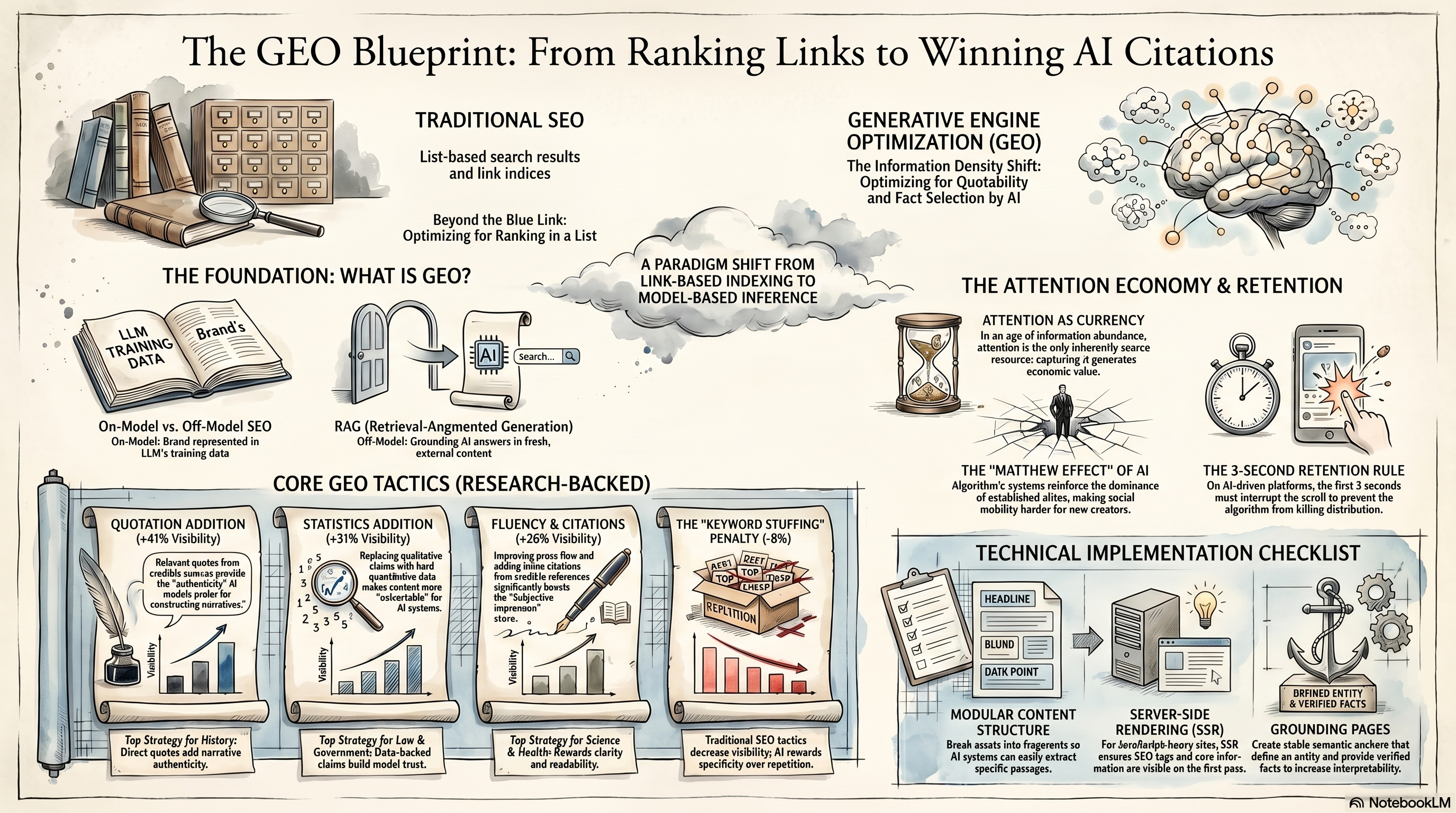
The GEO Blueprint for winning visibility inside ChatGPT, Perplexity, Google AI Overviews and Claude — as traditional search clicks collapse.
Get a free inside look at “Automated Funnels & Attention-Economy Monetization” — the module infographic and the video overview.
By the numbers
Move from scattered lessons into repeatable workflows, decision checkpoints, and practical learner assets.
Every module maps to a concrete operator workflow, learner lab, and reusable asset.
Course markdown, trainer resources, student guides, and lead magnets are distilled into buyer-ready messaging.
Use the checklists, guides, and templates to ship work during the course instead of waiting until after it.
Brands that get cited in AI answers earn visibility even when click-through rates collapse — AI citations build awareness before a user ever reaches a website (Emarketed/Gartner framing, 2026).
Early GEO adopters report that 32% of their sales-qualified leads now come from generative AI search, up from essentially zero months earlier (The Digital Bloom GEO Traffic Report, 2026).
4 modules, each ending in a deliverable.
Marketers, in-house SEO leads, content strategists, agency owners and founders who are watching organic traffic decline and need to win visibility inside ChatGPT, Perplexity, Google AI Overviews and Claude. It suits both B2B and B2C, from solo operators to enterprise teams.
Basic familiarity helps but isn't required. We cover the shared foundation (crawlability, indexing, E-E-A-T, structured content) before layering on the GEO-specific tactics, so beginners can follow and experienced SEOs can skip ahead to the new material.
You'll be able to audit your brand's current AI citation share, build citation-friendly and original content that AI engines quote, run a digital-PR plan that earns third-party mentions, and set up per-engine tracking for ChatGPT, Perplexity, Gemini and Google AI Mode.
Much of the free content still pushes hacks Google publicly debunked in May 2026 (llms.txt, content chunking, AI-only rewrites). This course is built on validated sources — Princeton's GEO-BENCH, Conductor's enterprise benchmarks, Adobe and Similarweb data — and tells you honestly which tactics work per engine and which are dead.
You need both. Google itself frames GEO as 'still SEO' for its AI features, so strong fundamentals carry over. The course shows where SEO and GEO overlap so you avoid duplicate work, and where GEO adds distinct levers you'd otherwise miss.
You can start with free and freemium tools to test prompts in ChatGPT, Perplexity, Gemini and Google AI Mode, plus your existing analytics. We cover paid citation-tracking platforms (Profound, Conductor, Semrush, Ahrefs and similar) as optional upgrades, not requirements.
The course is self-paced with bite-sized modules. Most learners complete the core material in a focused week and start applying the audit and content frameworks within the first few days.
Yes — we deliberately anchor on durable principles (authority, original research, citation share measurement, per-engine testing) rather than fragile hacks, and we explain how to re-test as engines update so your skills stay current.
All of them. We cover ChatGPT (which drives ~87% of AI referral traffic), Perplexity, Google AI Overviews and AI Mode, Claude, and Copilot — including how citation behavior and crawler treatment differ between them.
Very. A majority of B2B buyers now use AI assistants for supplier research before touching Google, AI-sourced B2B leads are reported to convert about 2x higher, and the course includes B2B budget-reallocation and share-of-voice frameworks.
The course includes a diagnostic workflow: most invisibility comes from AI engines being unable to retrieve, trust, or summarize your content. You'll learn to find which of those is failing and fix it, plus how to close gaps with third-party mentions where 85% of AI citations originate.
Yes — the course includes guidance resources and a way to get your questions answered so you're not implementing alone. (See the enrollment page for the current support and community details.)
Citation share is faster to move than classic rankings: case data shows mention rates can climb meaningfully within weeks of consistent original content and digital PR, with early adopters reporting a third of qualified leads from AI search within months.
Every benchmark we teach is sourced from named, current research — Gartner, Adobe Analytics, Similarweb, Seer Interactive, Ahrefs, Conductor, Princeton and Google's own 2026 documentation — and we flag where sources disagree so you're working from evidence, not hype.
Start with the syllabus, then move into the first operator sprint.